Map the usable area
Measure the floor, the opening through which equipment must pass, and the route you need for ordinary movement. Mark door swings and access to drains. A planter that fits on a drawing may still obstruct a balcony door or leave no safe place to stand with a watering can.
Observe light and wind at different times before committing to a permanent arrangement. A sunny wall can create a warm, dry pocket, while a railing can expose plants to drying gusts. Match plants to those conditions rather than expecting a container material to solve unsuitable exposure.
Sketch the layout at a simple scale and include room for mature growth. Climbing plants need supports, and bushy plants can spread across paths. Check the adult size listed by a reliable nursery or the Royal Horticultural Society, not just the size of the plant at purchase.
Make a bed reachable
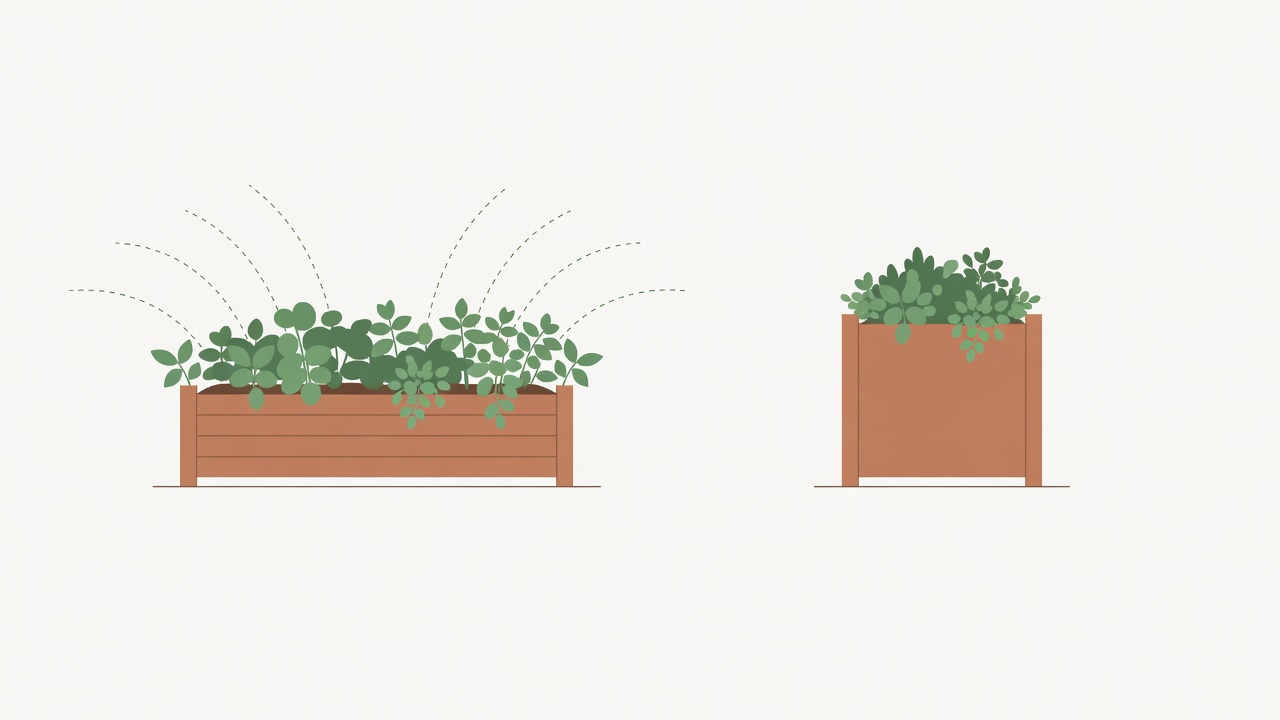
A raised bed works best when you can tend its centre without stepping on the growing medium. Test your comfortable reach from the actual working position. Access from both sides changes the usable width; a bed against a wall must be narrower if it is to remain easy to maintain.
Decide whether the bed sits on open soil or a hard surface. On soil, consider existing weeds, roots and drainage. On paving, plan how water will leave without carrying sediment into drains or creating a slippery route. A deeper frame does not automatically mean better drainage or healthier roots.
Calculate the internal volume before ordering fill: internal length multiplied by width multiplied by fill depth gives cubic volume when the units match. Account for the chosen planting depth and any settling. Do not use this volume as a structural loading assessment; wet growing media, the container and other loads all contribute to the final weight.
Compare container behaviour
| Material | Useful characteristic | Check before buying |
|---|---|---|
| Terracotta | Porous walls can support drying | Weight, frost suitability and faster moisture loss |
| Plastic or resin | Often lighter when empty | UV resistance, stability and replaceable parts |
| Timber | Easy to fit into simple bed shapes | Ground-contact suitability, treatment and joint durability |
| Metal | Can provide a slim structural profile | Edges, corrosion protection and exposed-surface heat |
For timber, FSC or PEFC certification concerns responsible sourcing within the certification’s scope; it does not by itself establish rot resistance or suitability for growing food. Ask for the wood species, treatment details and intended use. Keep product claims separate from what the certification actually covers.
For any pot, inspect drainage openings and whether they can remain clear. Saucers can protect surfaces but can also retain water. Empty them when appropriate for the plant and conditions. A layer of gravel is not a substitute for suitable drainage holes and an appropriate growing medium.
Treat balconies differently
Do not estimate a balcony’s safe load from its size or apparent strength. Obtain the relevant information from the building owner, manager or a qualified structural professional. Soil becomes heavier when wet, and concentrating several large containers in one area can matter as much as the overall total.
Freestanding planters avoid some railing-attachment problems, but they still need stable placement and wind assessment. Never assume a decorative railing is designed to hold a loaded planter. Check permission and the complete mounting system, including the way it is restrained against movement.
- Balcony: keep fire escape routes, drains and doors clear; prevent runoff onto neighbours.
- Ground-level garden: preserve wheelbarrow access and space to maintain adjoining structures.
- Both: place heavy containers before filling, unless a rated moving system and safe route are available.
Plan the ordinary care
Small pots can need frequent attention because their root zones hold limited water. Larger containers may buffer changes, but they are heavier and not automatically easier to manage. Self-watering planters add a reservoir that must be checked, cleaned and used according to the plant and product instructions.
Check whether a liner, overflow fitting, feet or support frame is included. These items can change the real price and working height. If you use castors, confirm the rated load includes the filled container and choose a stable, lockable arrangement appropriate for the surface.
Think through winter before buying. Some pots should be emptied or protected, and irrigation parts may need draining. Stackable containers save space only if their shape and condition allow safe stacking. Avoid storing damp organic material in a way that encourages decay or pests.
Choose a manageable start
Begin with a footprint you can reach, water and maintain during your busiest weeks. Expand after one season of observing plant growth and your own routine. Extra growing area is only useful when the supporting access, water supply and storage remain practical.
Product dimensions and loaded weights vary. This guide cannot certify a balcony, roof, railing or supporting structure.
Match the water system